“Anti-Aging” at 23 Backfired — Loudly
I tried to get ahead of aging by throwing every active ingredient I could find at my face, all at once, in my early twenties. For a few weeks, I looked noticeably worse — and more “aged,” ironically, than before I started.
CeraVe Moisturizing Cream
A simple, trusted everyday moisturizer pick for barrier support and dry skin routines.
Check priceI was 23 when I first felt genuinely anxious about a couple of faint lines forming between my eyebrows and at the corners of my eyes. Looking back, they were barely visible — the kind of thing you’d only notice under specific lighting, looking for it specifically. But I’d been seeing a lot of content about “preventative” skincare, the idea that the best time to start anti-aging products is before you think you need them, and something about that framing turned a couple of faint lines into a small crisis.
So I did what felt like the responsible thing: I researched the most effective anti-aging ingredients, bought several of them at once — a retinol serum, a vitamin C, a peptide serum, an exfoliating acid — and started using all of them, most nights, at what I assumed was “full effort” from day one. Within about two weeks, my skin was red, flaky in patches, and visibly irritated in a way that, if anything, made it look more tired and aged than the faint lines I’d been trying to address in the first place.
The Week Someone Asked If I Was Feeling Okay
About three weeks into this routine, a coworker asked, fairly gently, if I’d been sleeping okay — because I “looked a bit tired lately.” I remember being almost offended, because I’d been doing the opposite of letting myself look tired; I’d been doing more for my skin than I ever had before. But when I actually looked in the mirror with that comment in mind, instead of just glancing past it the way I usually did, the redness and slight flakiness around my nose and forehead were obvious. I’d been so focused on the two faint lines I was trying to fix that I’d stopped really looking at the rest of my face.
That was the moment I actually looked into what I’d been doing, instead of just pushing through because I assumed irritation meant the products were working hard. What I found, roughly: introducing multiple strong actives simultaneously is a pretty reliable way to compromise your skin barrier, and a compromised barrier shows up as redness, dryness, and a rougher texture — all of which, descriptively, are things people associate with older-looking skin. I’d taken two faint lines and traded them for a face that looked irritated and uneven for about a month while things calmed back down.
What I Actually Changed
The first change was the least exciting one: I stopped everything except my basic cleanser, moisturizer, and sunscreen for about two weeks, and let my skin recover. The redness and flakiness resolved within that window, faster than I expected — which on its own told me how much of what I’d been seeing was irritation, not “before” skin that genuinely needed fixing.
After that, I reintroduced things one at a time, slowly, starting with the one ingredient that has the most consistent evidence behind it for the actual concern I had (fine lines) — retinol — at a much lower frequency than I’d started with the first time. Everything else either got reintroduced much more gradually over the following months, or quietly didn’t come back at all, because once my skin had calmed down, I genuinely couldn’t tell whether some of those other products were doing anything noticeable on top of the basics.
The Products That Actually Earned Their Spot
Same approach as the rest of this series — what’s actually stuck, the second time around, done more slowly.
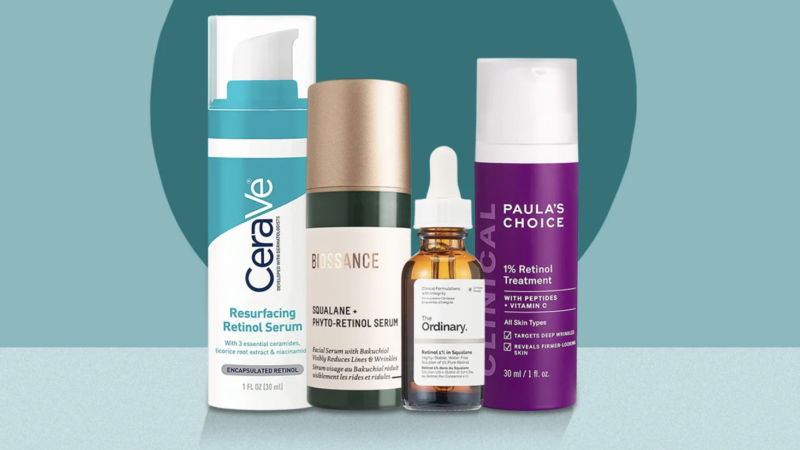
CeraVe Skin Renewing Retinol Serum
This was my reintroduction point, and the formulation matters here in a way I didn’t appreciate the first time around — it’s built with ceramides and niacinamide alongside the retinol specifically to be gentler on the barrier than a plain retinol would be. Starting at twice a week instead of “every night, immediately,” I didn’t get any of the redness or flaking from round one. It took longer to notice anything — closer to two months than two weeks — but “took longer and didn’t wreck my skin” was a trade I was much happier with than the alternative.
The Ordinary “Buffet” + Copper Peptides 1%
This was the one ingredient from my original lineup that I brought back, mostly out of curiosity, once everything had settled. I genuinely can’t point to a specific, isolated change from this one the way I can with the retinol — it’s gone in without any irritation, which after the first round felt like a meaningful bar to clear on its own, and it’s stayed in my routine on the nights I’m not using retinol. I’d describe my honest relationship with this product as “hasn’t caused a problem, might be doing something, no complaints” — which is a pretty different review than the dramatic claims I was hoping for when I first bought it.
RoC Retinol Correxion Deep Wrinkle Night Cream
This came later, after the serum had been in my routine without issues for a couple of months — a richer, cream-format retinol product I now use a couple of nights a week instead of the serum, mostly because the texture feels nicer during drier months. I don’t use this and the serum on the same night; it’s one or the other, depending on how my skin feels and what season it is. The “deep wrinkle” framing on the packaging is, predictably, more dramatic than what I’d describe as my actual experience — but as a richer retinol option for nights my skin wants something more substantial, it’s earned a place.
The Ingredient I Didn’t Need to “Add” — Because I Already Had It
Here’s the part of this that genuinely surprised me most: by a wide margin, the product in my routine with the strongest evidence behind it for the exact thing I was originally worried about — fine lines, skin aging generally — was the sunscreen I’d already been using, the one I wrote about in a different post on this exact topic. I’d been treating sunscreen as a separate, unrelated step from my “anti-aging routine,” when in terms of actual long-term impact, it’s arguably doing more than anything else in this post.
I don’t think this is a popular thing to say, because it’s not exciting — there’s no new product to buy, no ingredient to discover, just “the boring step you’re (hopefully) already doing.” But going through the whole irritation-and-recovery cycle described above, and then learning that the single most evidence-backed “anti-aging” habit was one I’d already had in place the entire time, was a pretty humbling thing to realize.
Two Habits I Had to Unlearn
Starting “as strong as possible” because I felt behind
The framing that got me into trouble was feeling like I was already late — that if 23 was when I should have started, and I’d only just begun, I needed to make up for lost time by going in hard. There’s no “behind” with this stuff in the way that framing implied; starting gently at 23, or 33, or later, and giving things time to actually work without irritation, seems to matter much more than the exact age you start or how intensely you start.
Treating irritation as a sign of progress
This is really the core mistake, and I think it’s a common one — there’s a narrative around actives that “your skin needs to get worse before it gets better,” and I leaned on that narrative hard during my first attempt, interpreting redness and flaking as evidence the products were doing serious work. Some mild, brief adjustment period for certain actives is real and expected. Ongoing redness, flaking, and a coworker asking if you’re feeling okay is not “purging” — it’s your skin telling you something is too much, and the version of “anti-aging” that actually involves less inflammation and a healthier barrier is, definitionally, the one that doesn’t look like that.
What My Routine Actually Looks Like Now
☀️ Mornings
Cleanser, vitamin C, moisturizer, sunscreen — the same basics from the other posts in this series. This routine, on its own, is probably doing more for “anti-aging” than anything in the rest of this article.
🌙 Evenings
Cleanser, then either the CeraVe retinol serum, the RoC retinol night cream, or the Buffet peptide serum — never more than one of these three on the same night — then moisturizer.
Questions I Get Asked a Lot
What age should I actually start using “anti-aging” products?
I don’t think there’s a specific age that matters as much as the framing implies — what seems to matter more is starting gently, whatever age that is, and not treating “earlier and stronger” as automatically better. If I could redo my early twenties, I’d keep the sunscreen exactly as is and introduce a gentle retinol slowly, without the panic-buying of everything else at once.
How do I know if irritation from a new product is normal or a sign I should stop?
Based on my own (not great) experience: mild, brief sensitivity in the first week or two of a new retinol, especially, can be normal. Ongoing redness, visible flaking, or other people commenting that you look tired or unwell is not something I’d push through again. The “give it time” advice applies to waiting for results, not to waiting out genuine irritation.
Is sunscreen really more important than retinol or peptides for aging?
Based on what I’ve read and on my own experience of having one already in place the whole time without realizing how much it mattered — yes, by a significant margin, at least for prevention. Retinol and similar ingredients seem to matter more for addressing things that have already started to show up; sunscreen seems to matter for how much shows up in the first place.
Can I use retinol and peptides on the same night?
I don’t, mostly out of caution after my first round — I keep them on separate nights. I don’t have strong evidence that combining them would cause a problem the way combining retinol with vitamin C or acids did in my serum routine, but after the experience described in this post, “one new thing at a time, slowly” has just become the default for everything, not only the things I know specifically conflict.
The Actual Takeaway
If “anti-aging” has started to feel like a category you’re behind on — something you should have started earlier, with more ingredients, more intensely — I’d gently push back on that framing based on my own experience with it. The version that actually held up, for me, wasn’t more aggressive. It was slower, narrower, and leaned heavily on a step I’d already had in place for years without thinking of it as part of this category at all.
The two lines that started this whole thing are still there, more or less. What’s different is that I stopped treating “more, faster, stronger” as the goal, and started paying attention to whether my skin actually looked and felt healthy from one week to the next — which, it turns out, was the thing actually worth optimizing for the whole time.
Featured product pick
Compare price, availability and product details before buying.
Este conteúdo pode conter links de afiliados. Podemos receber comissão por compras qualificadas, sem custo extra para você.